Nepal A Concise History of the Cultural Scenario of the Himalayan Kingdom
by Jagdish Shumsher Rana.
ISBN 81-85693-24-2 1993. Hard pp.242. Rs. 295.
Trance Initiation and Psychotherapy Nepalese Shamanism
Essays on Tamang and Tibetan Shamanism
by Dr. Larry G. Peters.
ISBN 81-85693-79-X 2004. Hard pp.412. Rs. 595.
Folk Tales of Sherpa and Yeti Collected by Shiva Dhakal
Adapted by Yuyutsu RD Sharma.
ISBN 81-8250-002-0 2009. Paper pp.125. Rs. 195.
Recent Nepal An Analysis of Recent Democratic Upsurge and its Aftermath
by Laksman Bhadur K.C.
ISBN 81-85693-24-2 1993. Hard pp.242. Rs. 295.
The Price of Heaven Travel Stories from India and Nepal
by Evald Flisar.
Translated from Slovene
by the Author & Alan McConnel-Duff.
ISBN 81-8250- 020-6 2009. Paper pp.200. Rs. 195.
Tamang Shamans An Ethnopsychiatric Study of Ecstasy and Healing in Nepal
by Dr Larry G. Peters.
ISBN 81-8250-009-5 2007. Paper pp.179. Rs. 295.
Ocean in a Drop Yoga, Meditation and Life in the Himalayas
by Swami Chandresh.
ISBN 81-8250- 005-2 2006. Hard pp.348. Rs. 495.
The Gurkha Connection A History of Gurkha Recruitment in the British Army
by Purushottam Baskota.
ISBN 81-85693-77-3 2009. Paper pp.221. Rs. 195.
Dolpo :The Hidden Paradise A Journey to the Endangered Sanctuary of the Himalayan Kingdom of Nepal
by Karna Sakya.
ISBN 81-85693-73-0 2006. Paper pp.246. Rs. 295.
Malla Coins of Medieval Nepal
by Jagdish Chandra Regmi
ISBN 81-85693-60-9 2009. Hard. Rs. 295.
The Dhimals: Miraculous Migrants of Himal An Anthropological Study of a Nepalese Ethnic Group
by Rishikeshab Raj Regmi.
ISBN 81-8250-009-7 1991. Hard pp.269. Rs. 195.
The Gurungs: Thunder of Himal A Cross-Cultural Study of a Nepalese Ethnic Group
by Murari P. Regmi
ISBN 81-85693-49-8 2002. Paper pp.238. Rs. 295.
The Gurkhas A History of the Recruitment in the British Indian Army
by Kamal Raj Singh Rathaur.
ISBN 81-85693-85-4 2000. Paper pp.128. Rs. 195.
The Political Economy of Land,
Landlessness and Migration in Nepal
by Nanda R. Shrestha.
ISBN 81-85693-87-0 2001 Hard pp.309 Rs. 450
Mountain Dimensions An Altitude Geographic Analysis
of Environment and Development of the Himalayas
by Ram Kumar Pandey.
ISBN 81-85693-43-9 1999. pp.260 Hard. Rs. 350.
Wildlife in Nepal
by Rishikesh Shaha & Richard M. Mitchell.
With Color Plates by Nanda Shumsher J.B. Rana.
ISBN 81-85693-31-5 2001. Paper pp.142. Rs. 250.
Making of Modern Nepal A Study of History, Art and Culture of the Principalities of Western Nepal
by Ram Niwas Pandey.
ISBN 81-85693-37-4 1997. Hard pp.816. Rs. 795.
Politics and Development in Nepal: Some Issues
by Narayan Khadka.
ISBN 81-85693-21-8 1994. Hard pp.477. Rs. 450.
Art and Culture of Nepal An Attempt towards Preservation
by Saphalya Amatya.
ISBN 81-85693-63-3 1999. Hard pp.282. Rs. 295.
Popular Deities, Emblems and Images of Nepal
by Dhruba Krishna Deep
ISBN 81-85693-39-0 2003 Paper pp.180 Rs. 150
Vishwarupa Mandir A study of Changu Narayan, Nepal’s most Ancient Temple
by Jeff Lidke.
ISBN 81-85693-59-3 2000. Hard pp.213. Rs. 1495.
Religious Minorities in Nepal An Analysis of the State of Buddhists & Muslims in the Himalayan Kingdom
by Mollica Dostider.
ISBN 81-85693-47-1 1996. Hard pp.213. Rs. 185.
Fire of Himal An Anthropological Study of the Sherpas of the Nepal Himalayan Region
by Ramesh Raj Kunwar.
ISBN 81-85693-64-1 1999. paper pp.314. Rs. 295.
The Khasa Kingdom A Trans-Himalayan Empire of the Middle Ages
by Surya Mani Adhikary.
ISBN 81-85693-50-1 1997. Paper pp.215. Rs. 250.
Bhutan: A Movement in Exile
by J.D.N.S. Dhakal & Christopher Strawn
ISBN 81-8250-001-2 2009. Paper pp.242. Rs. 395.
Encounter Wildlife in Nepal
by Karna Sakya.
ISBN 81-85693-38-2 1993. Hard pp.296. Rs. 495.
Nepal-India Democracy in the Making of Mutual Trust
by Dinesh Bhattarai & Pradip Khatiwada.
ISBN 81-85693-36-6 1993. Hard pp.324. Rs. 295.
The Himalayan Mind A Cross-cultural Nepalese Investigation
by Murari P Regmi.
ISBN 81-85693-29-3 1997. Hard pp.240. Rs. 250.
Kathmandu Patan & Bhaktapur An Archaeological Anthropology of the Royal Cities of the Kathmandu Valley
by Rishikeshab Raj Regmi.
ISBN 81-85693-30-7 1997. Hard pp.111. Rs. 250.
A Glossary of Himalayan Buddhism
by Jagdish Chandra Regmi.
ISBN 81-85693-28-5 1994. Hard pp.212. Rs. 250.
1. Prof. Deborah Landau of New York University has described you as ‘a new poet with seasoned soul… has a gift for narrative…” How do you respond to this? Where do you think this gift comes from?
Ultimately, the creative process is a mystery. Much can be made of the various filters through which a poet produces his work (cultural, literary, religious, political), but at the final moment when the creation of the poem begins, when the words are arranged on the page, when a narrative takes off, then a mystery is present, something almost holy and strange, which makes the poem seem to appear ex nihilo, out of nothingness. Where does this mystery come from? My own experience is that this comes as a direct result of a poet’s communing with God, with the numinous.
2. Your new book, Little Creek has the Vietnam War and other wars as the backdrop. How close were you to these wars? How did they affect your life and your writing?
The war in Viet Nam was a very divisive conflict for Americans, especially for those growing up in the 1960s. I was too young to be drafted into the military and deployed to Viet Nam, but many of my friends who were several years older did in fact serve during the conflict. My own brother-in-law was a combat soldier during the Tet Offensive. Little Creek focuses on a group of young men who were deployed to Viet Nam and who died there. The poem is a way of honoring them.
3. Can you describe the genesis of your ambitious ongoing poem, Olympus Mons? What made you imagine the NASA conquest of Mons? What is your point in doing so? Why do you keep adding chapters to it every year?
I’ve been fascinated with the exploration of space since I was a child, and Mars (both as a destination for scientific research, and as a source of anxiety regarding first contact with alien life) has been a huge preoccupation of popular culture in the United States going back to the 1930s. “The Final Pitch on Olympus Mons” started out as a narrative about astronauts walking to the summit of this enormous volcano, but then quickly transformed into something else as the back-story began to emerge. For example, the concept of “final pitch” became more than a baseball “pitch” by which the astronauts retained their familiar home-connections with Earth, as well as their sanity. Pitch (or tone) also referred to the “beacon” heard by the astronauts on the Martian surface; and finally the mountaineering “pitch,” a specific distance over which the climbers ascended before stopping to rest as a group.
4. There is strong influence of your early life, especially childhood, on your work and great deal of your biographical detail forms the bedrock of your poetry in Little Creek. Can you elaborate on this?
I grew up in the southern part of the United States during the 1950s and 1960s, and the small-town culture of the South that I knew is rapidly fading away as the high-tide of globalization sweeps into every corner of the planet. In part, my writings about childhood are an attempt to capture something of that more innocent time, before it disappears altogether.
5. Why do you write?
I work in order to relax. In other words, the very precious hours I have during the week to work on the poems are calming and strengthening.
6. How does your new role as a poet impinge on your vocation as an administrator and educationist?
My professional life in the university provides amazing experiences which often serve as launch platforms for poems, for example my work in Belize which made its way into “Palm Sunday in Dangriga Town.” The greatest challenge is finding a balance point between professional life and artistic life. I simply don’t have as many hours to write during the week as I wish I did!
7. There is a strong element of Asia, especially Hindu mythology, evident in your forthcoming pillow book, Garuda & Other Poems? Do you have any special Asian connection in your upbringing?
Growing up in the South, I did not have international opportunities when I was young. When I left for university in 1972, I began meeting students from all over the world. Later I was able to teach international students in class, and then work for the students as an adviser to international students. My fascination with Asian culture stems both from my work in International Education, and from my travels in Asia. Also I’m enthralled with the antiquity of Hinduism and the similarities that exist between Hinduism and Christianity.
8. Poet Yuyutsu Sharma has portrayed you as a poet with ‘a world belong heights.’ Recently, you also did a reading with him in New York City, entitled, Poetry and Heights. How does the issue of Heights connect both of you?
Yuyu Sharma’s poetry is rooted in religious philosophy (which permeates his work) and the powerful sense of place, mystical and physical, that exists in the Himalayas. This has had a huge resonance in my own writing. I spent a great deal of time in the mountains of North Carolina (which compared to the Himalayas are hillocks!), and this instilled in me a sense of heights which is full of longing and mystery. C.S. Lewis described going “further up and further in” to a greater reality of life beyond that which we currently live. This stirs something very deep, like the skirl of the bagpipes far up in the highlands of North Carolina; and it filters through, as for example in “A Ghost Among Ghosts.”
9. How do you look at contemporary poetry scene in the United States? Is there any tradition in American literature that you think you belong to? Any other writers from the rest of the world you wd like to mention?
In a general sense, the poetry scene in the United States is self-absorbed and inwardly focused. At its best, it is amazingly insightful and moving (as in Mark Strand’s wonderful verse). What often seems lacking in American poetry is an awareness of the world, of cultures beyond those represented in a particular region of the United States. Americans need to think more in terms of interacting in the world (something which has been difficult for people in the United States), and in terms of what it means to interact in the world in a non-harmful way. I would love to read more poets who are struggling with globalization, with culture-collision, with international coexistence in a static and fragile ecosystem.
10. As mentioned in your profile to Little Creek, your mother sent poetry to you all through your college with her letters and your father read Shakespeare and Coleridge to you as a child? How did this influence your writing patterns? Moreover, how do you view today’s reading and writing scene in a world of cyberspace where electronic devices like Kindle and IPod loom large over future of printed books?
My parents, especially my father, instilled in me a deep respect for literature. Certain writings were sacrosanct: the Holy Bible; the plays of William Shakespeare; the writings of the Romantic Poets. My mother taught me that a Southern gentleman must read three things: the Bible, Shakespeare, and The Pilgrim’s Progress (by John Bunyan). I learned early on that the study of literature does not require speed-reading. In fact, it requires the opposite: a willingness to invest time, imagination, thoughtfulness in the printed word. Technology is changing and accelerating knowledge transfer to the point that gist becomes more important that a thing in its totality (for example an outline of David Copperfield as opposed to deep familiarity with the lengthy work in its entirety). To be specific, modern students spend a great deal of time in very fast knowledge acquisition, and less and less extended time with specific complete texts. As you can imagine, this does not bode well for the reading and re-reading required by poetry. Also in the future, readers may be so used to Kindle that they are never exposed to the feel, the smell, the weight of a printed book. What a loss!
11. Your poetry book has just appeared in the Nirala Series. How do you see this, your work finding a publisher and read so far away from your homeland?
Two things come to mind. The first is that Little Creek being published by a company in India is nothing less than a miracle! Secondly, however, it seems perfectly in keeping with globalization, that our world’s cultures and people are drawing closer together than ever in history, and that the arts are benefitting hugely from the interactions and interconnections occurring from globalization.
12. What are you writing now?
I have two projects which I’m currently working on. The first is a chapbook (pillow book) that Nirala Press will publish in 2012. Nirala has asked me to focus further on the concept of heights, and this has become a very interesting project, and one which I hope readers will enjoy. The other project is an extended series of poems focusing on the enigmatic character of St. Joseph of Arimathea.
13. What advice do you have for younger poets?
My advice to younger poets is the same as I’ve given to my students and to my own daughters: Never stop reading books!
Her Excellency Verena Gräfin von Roedern, Ambassador of the Federal Republic of Germany addressing the audience
The Himalayan Times News, December 4, 2011
Book with good subject matter widens your perspective and contains the magical element.
The Nepal Trilogy -three volumes of books that contain photographic and poetic journey through the areas of Annapurna, Everest, Kelambu and Langtang give a similar feeling when you read them. And these books were you read them. And these book launched by Verena Grafin Von Roedern, Ambassador of Germany at the Nepal Tourism Board on December 4. The books have been already launched in European cities Frankfurt, New York, London and Paris earlier.
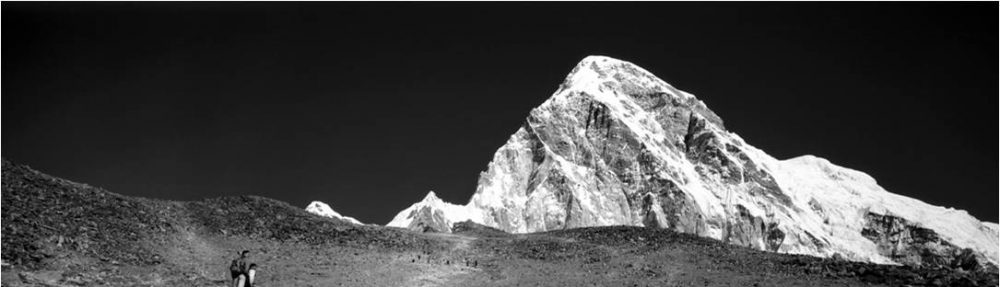
These books are a joint project of German Photographer Andreas Stimm and Nepali Poet Yuyutsu RD Sharma, which took 10 years to get completed. These books contain black and white panoramic photographs of the Himalayas and inhabitants of those areas taken by Stimm together with 63 poems by Sharma in two languages -English and German. Sharing about the benefits of their fusion works, Sharma expressed, “The fusion of photography and poetry has revived the soul of Nepal.“
At the event Sharma recited three of his poems from the books in English.
Meanwhile Dr. Manfred Treu, Professor of German at Bishwo Bhasa Campus, Stimm and his wife Cornelia Dewein recited those three poems in German Launching the books, Roedem expressed, “Stimm has captured not only the flora and fauna of those places but also the spirit of people by capturing their lifestyle, religion and culture where Sharma’s poem support the photographs and give them soul.“
Stimm, impressed by the Nepali people stated, “Whatever pain Nepali people face, they are always smiling and their welcoming behaviour and hospitality has really impressed me.“
The book has been published by Epsilonmedia, Germany and White Lotus Book Shop is its distributor in Nepal. -HNS
Yuyutsu and Stimm before the Launch at Nepal Tourism Board
Yuyutsu Sharma :March month readings in Colorado and New York
• Saturday March 5, 2011: 7 pm : Journey through India and Nepal: Yuyutsu Sharma reading with Robert Scotto and Lu Wu at the Jujo Mukti Tea Lounge, 211 East 4th Street (between Avenues A and B ) New York, NY, 10009 , 212-533-4075) Scotto will read his new work from his travels in India and Nepal with Photographer, Lu Wu. Yuyutsu will read from his new poetry/picture book, Nepal Trilogy (www.nepal-trilogie.de, Epsilonmedia, Germany), authored with German photographer, Andreas Stimm. Wu will project a selection of her photographs from the journey during the reading
• Friday March/4 7:30pm Yuyu featuring at the Poets Aloud bj spoke gallery 299 Main St., Huntington, Long Island
• Sunday March 6, 2011: ( 7 – 10 pm) Amazing Poetry Eventat the Glovinsky Gallery 8th and Inca, Denver.Co. Use Inca Street Entrance, http://www.glovinskygallery.comYuyutsu with read with Janet Glovinsky. We will follow the intermission with an open mic! Denver poets! Please come and bring your poems this will be a great event! 7 to 9 pm.
• Monday March 7, 2011 (starts 6 – 9pm): Namaste: Poetry as its Meant to Be! at Hearthfire Books of Evergreen 1254 Bergen Parkway (in the shopping center across from King Soopers) Please join Nepal/India’s celebrated poet, Yuyutsu RD Sharma, during his brief visit to Colorado. Local poets Laura Paul Watson of Pine and Padma Thornlyre of Kittredge will also present their work. Brought to you by Hearthfire Books and Turkey Buzzard Press.
• Tuesday, March 8 2011, ( 7 – 8 pm) Yuyutsu reading at The Center of Inner Peace, 740W 15th Street, Pueblo, Colorado 81003
•Saturday March 12, 7pm,Yuyu reading, The Ganesha Connection: Poetry Reading by Yuyutsu Sharma & Mikelle Tersonat the Jujo Mukti Tea Lounge, 211 East 4th Street (between Avenues A and B ) New York, NY, 10009 , 212-533-4075) Mikelle shall read her work inspired by Yoga and love and display samples of her jewelry. Yuyutsu will evoke the soul of the Gods and read his work from his new book on Helambu region of the Himalayas, authored with German photographer, Andreas Stimm
•Sunday March 13, 3pm, Yuyutsu reading his Select work with other American poets at the Space onWhite, 81 White Street, New York, NY 10013
• Monday March 14, 7pm,Yuyutsu reading from his new edition of his book, Hunger of our Huddled Huts, Poetry Venue, Starbucks Little Neck 251-41 Horace Harding Expressway Little Neck, NY
Yuyutsu Sharma is one of Nepal’s leading poets published by Nirala Publications, and has a growing international reputation. He is currently in New York, and has five forthcoming readings there, details below:
• December 30, 2010: at the Blue Mountain Gallery, 530 West 25th Street, 4th floor, New York, NY 10001 (between 10th and 11th Avenues). Tel: 646 486 4730. Yuyutsu Sharma will be reading from his ‘Nepal Trilogy.’ (This is a private reading with limited seats, please email here if you intend to come)
• January 1, 2011 (between 10 and 12 pm) at the Bowery Poetry Club, 308 Bowery, (Between Houston and Bleecker), F train to 2nd Ave, 6 to Bleecker.tel: 212-614-0505. Yuyutsu will be reading as part of the ‘17th Annual Alternative New Year’s Day Spoken Word / Performance Extravaganza‘,
• Monday January 3, 2011 (starts 7.30pm): at the Saturn Series Poetry Reading, Nightingale Lounge, 213 2nd Avenue, NYC @ 13th Street. A short walk East of Union Square. $3.00 entrance. Yuyutsu will be featuring.
• Thursday January 13 (from 6 – 7:30 p.m.)- Lower Branch Library, 2600 Bayshore Rd., Villas, NJ 08251. Tel: 609 886 8999.Yuyutsu Sharma and Diane Hamilton will be reading at the launch of Diane Hamilton’s ‘Lizard Licking, Donegal & Other Poems’, published by Nirala Publications.
• Saturday January 15(6:00 pm) - Yuyutsu will be reading from his Helambu book at the Utopian Directions, 7 West st. Warwick Village, N.Y.
Meena Ojha is a well known Nepalese political analyst.
His new book, Student, Politics & Democracy in Nepal, 1940-2008 has just been published by Nirala Publications.
Up-to-date and authentic, empirical and original, Student, Politics & Democracy in Nepal looks at the turbulent chapters of Nepalese history from a fresh angle. Offering a fine fusion of journalism and contemporary history, Meena Ojha examines the role of student movements in shaping the fate and future of contemporary Nepal, and asks several formidable questions —
What may be the causes of student movements?
Why do only students initiate movement and remain at the forefront?
What are the causes, and results of the movements?
Where and who make the plans and programs of the movements?”
Based on first hand research including interviews of over a hundred student leaders, posters, booklets, leaflets, bulletins and several materials provided by different student organizations, the book opens new doors to understand the ongoing political commotion that at the moment seems to draw worldwide attention.
Student, Politics & Democracy in Nepal, 1940-2008 by Meena Ojha. ISBN 81-8250- 025-7 2012. Hard pp.437. Rs. 795.
20 November, 2010 2 pm - Yuyutsu Sharma launches David B. Austell’s “Little Creek & Other Poems” published by Nirala Publications.
The video (above) is by Sahadev Poudel for Himali Sworharu, New York, NY (www.nepaliradio.org). Several fellow poets read from the book, and there was live music and multi-media.
In the video below Yuyutsu Sharma tells the story of, and reads ‘Space Cake, Amsterdam’, recently published in a collection of his poems by Howling Dog Press.